Thought
Business
How do we create a knowledge base for a company?
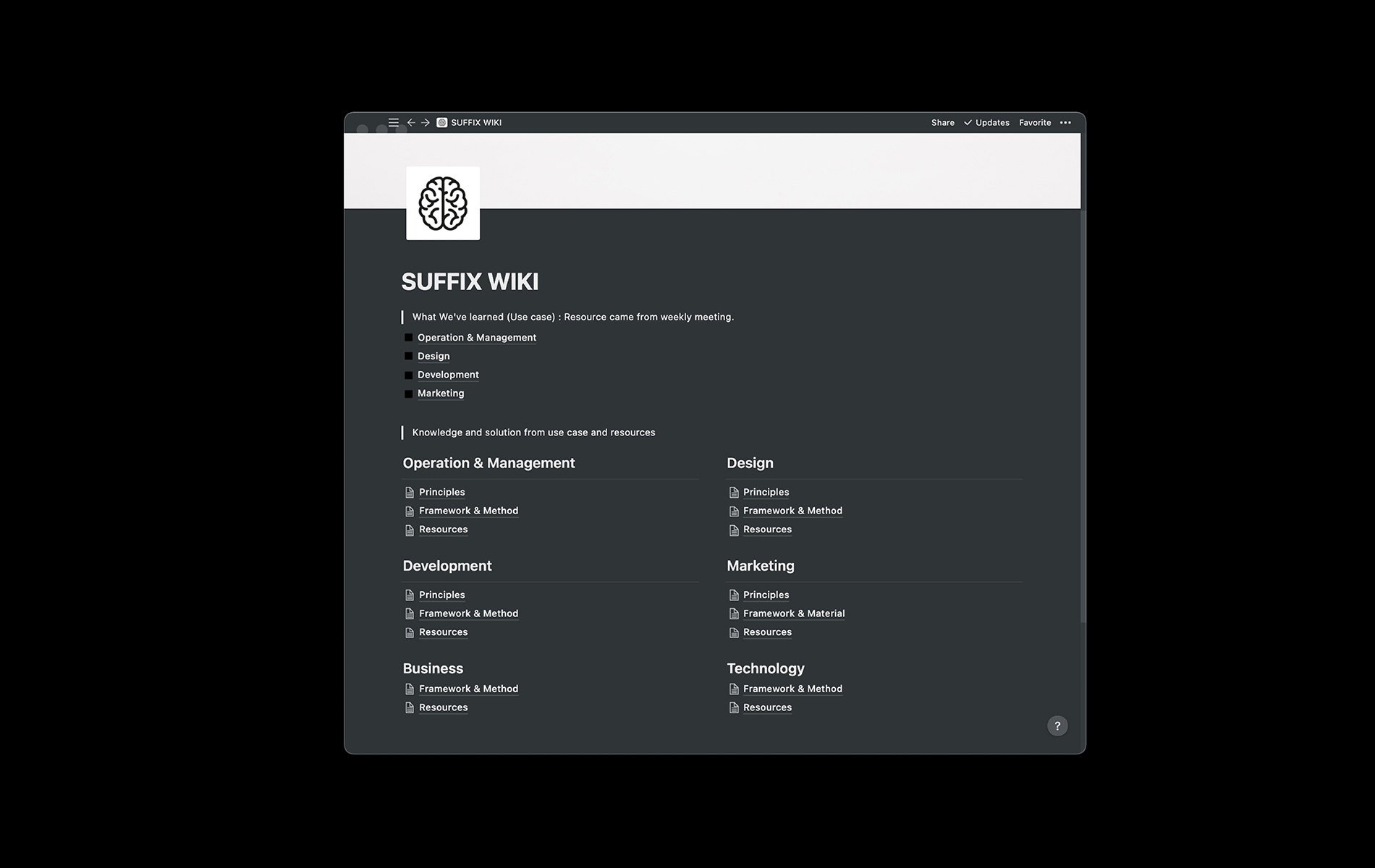
The first question before creating a Knowledge Base is: What are we creating it for?
• Record different work procedures and methods.
• Document solutions to problems that have occurred.
• Enhance the source of working methods and solutions because all the information is collected from everyone involved.
The next question is: Who are we creating it for?
In this case, we are creating it for internal use at SUFFIX. Therefore, the creation, recording, and organization of the Knowledge Base will be as follows:
We will divide the information for each team and categorize it as:
• Operation & Management for the coordination team (Account Executive)
• Design for the design team (UI/UX Designer, Graphic Designer)
• Tech Development for the development team (Front-end Developer, Back-end Developer, Software Tester)
• Marketing for the marketing team (Strategic Planner, Media Planner, Media Optimizer, Content Editor)
Each topic's details will include various thought frameworks (Framework), resources (Resource), case studies (Use-cases), and work principles (Principle).
The third question is: How do we create a Knowledge Base for SUFFIX? What are the knowledge sets, information, and case studies derived from?
Data Recording
Since 2010, SUFFIX has primarily used written communication, whether internal communication through various software (Communication Tools) such as Basecamp, Teamwork, Slack, Asana, Google Chat, or emails, which includes communication with clients and relevant teams from the client's software companies or different suppliers. Compiling all this data takes time because it involves logging into each platform used by SUFFIX and collecting and reorganizing all logs.
*We record and organize other forms of data like voice and images in Google Drive.
Data Organization
• Separate data based on the business unit (Business Unit).
• Case studies (Use-cases) arising from communication in Communication Tools and weekly meetings in each team.
• Thought frameworks (Framework), arising from studying various ways of thinking about work, working, or coordination, are recorded to provide alternatives or create diverse thinking methods when encountering work problems or coordination.
*Frameworks for various work aspects, whether it's a systematic design (Design System) for the design team or technology selection for the web development team, are included here.
• Work principles, which are principles arising from work procedures such as SUFFIX's remote working and recurring Use-cases.
Using and Selecting Software
We choose software that allows setting permissions, whether it be a private system for internal use or a public system for new team members who want to study the work before starting.
Other functionalities include easy searching and the ability to add, edit, or remove, as well as supporting various data formats.
Currently, SUFFIX primarily uses Notion to compile the company's knowledge base.
“Our knowledge always increases, but at the same time, our memory is limited, and over time, memories can become distorted from reality or even biased. The same is true for a company's knowledge and information.”
Writer
Director
Jate Saitthiti